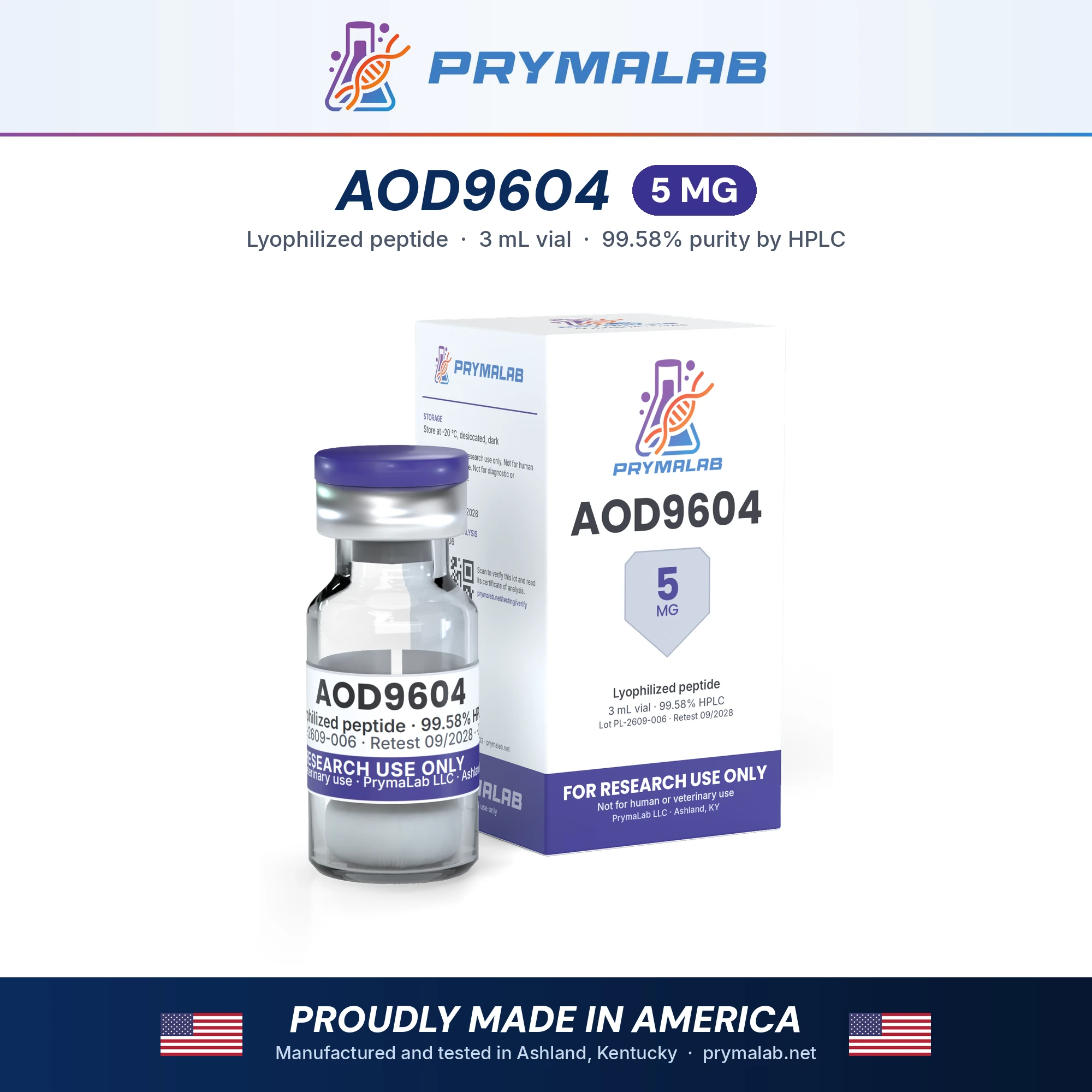
The report covers AOD-9604 5 mg powder, lot PL-2609-006.
Certificate PL-26-00006 identifies a lyophilized powder with a 5 mg-per-vial label claim. It describes two sampled units from a lot of 250, and explicitly identifies the analysis as in-house.
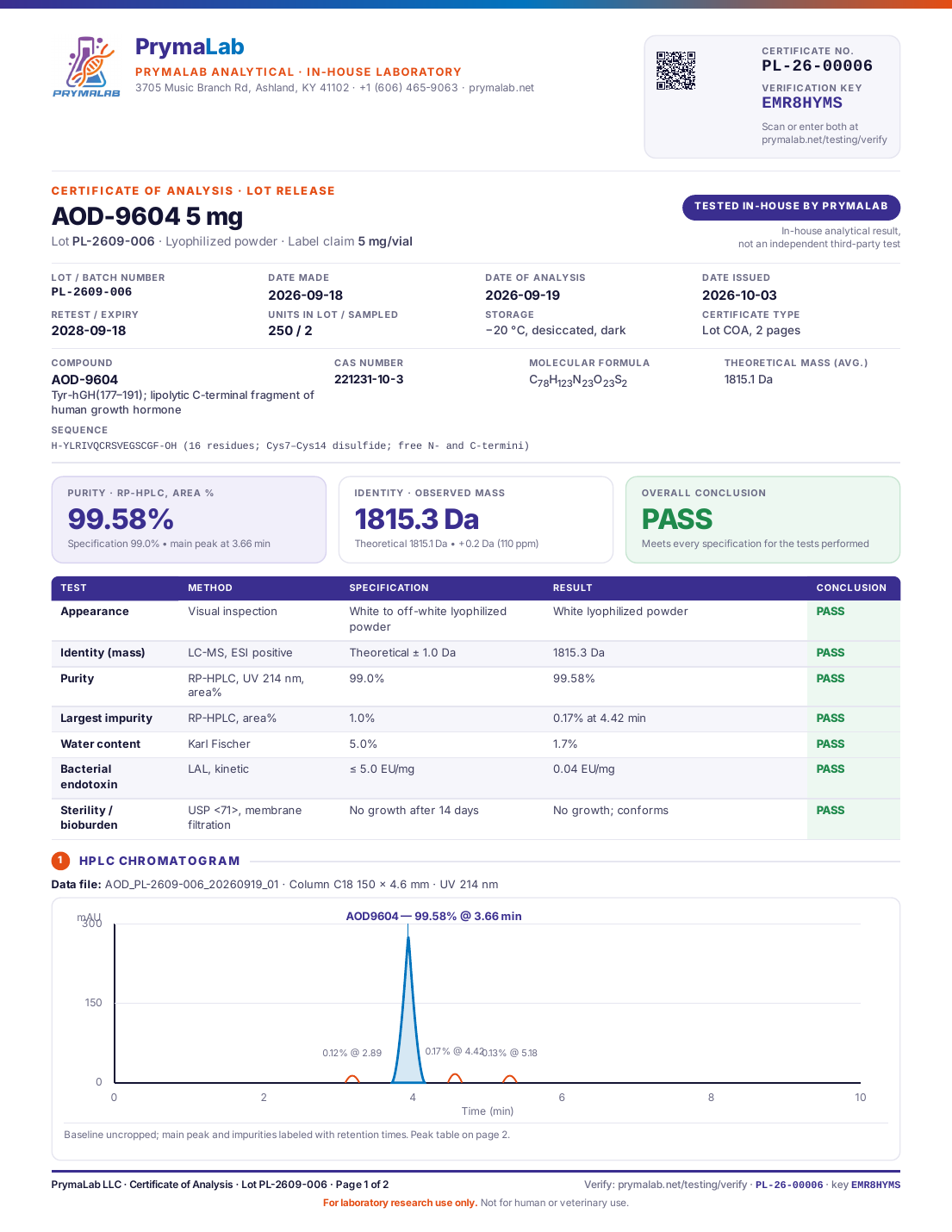
The test scope stays attached to the sampled powder.
The document is not an independent third-party test. Its conclusion concerns the tests performed on the named lot; it does not mean every vial was individually tested or a finished pen or spray was evaluated.
| Product | AOD-9604 5 mg |
|---|---|
| Form | Lyophilized powder |
| Lot | PL-2609-006 |
| Certificate | PL-26-00006 |
| Verification key | EMR8HYMS |
| Issued | October 3, 2026 |
The original states laboratory research use only, not human or veterinary use. Hosting the document is not an independent authentication of the laboratory work.
Identity, purity and milligrams are different measurements.
The measured mass stated in the LC-MS identity section.
Theoretical reference: 1815.1 Da.The main peak’s share of integrated HPLC detector area.
It is not a percentage assay of every material in a vial.The stated amount per vial.
No separate quantitative fill-content assay is supplied.A mass match supports the laboratory’s identity conclusion. An HPLC area percentage describes the chromatographic result under that method. Neither entry, by itself, verifies that an individual container contains exactly 5 mg. Source: original certificate, pages 1–2 ↗
The main peak area calculates to exactly 99.58%.
The chromatogram places the AOD-9604 main peak at 3.66 minutes. Page 2 supplies four numerical integration entries, so the reported area percentage can be checked directly.
4,281,940 ÷ 4,300,000 × 100 = 99.58%
| Peak | Retention time | Integrated area | Area share |
|---|---|---|---|
| 1 | 2.89 min | 5,160 | 0.12% |
| 2 · AOD-9604 | 3.66 min | 4,281,940 | 99.58% |
| 3 | 4.42 min | 7,310 | 0.17% |
| 4 | 5.18 min | 5,590 | 0.13% |
| Total | — | 4,300,000 | 100.00% |
The three smaller peaks total 18,060 area units, or 0.42%. The largest is the 0.17% peak at 4.42 minutes. The table, main-peak annotation and headline percentage agree; no numerical discrepancy was found in this calculation.
The stated method defines the reported result.
The certificate specifies RP-HPLC with a C18 column, UV detection at 214 nm, a water/acetonitrile gradient with 0.1% TFA and a 10-minute run. The integration threshold is 0.05% area; blank subtraction is marked yes.
0.5 mg/mL belongs to the laboratory method.
That figure is the analytical sample concentration. It is not the pen strength, a consumer reconstitution instruction or a statement of the spray’s concentration.
The reported mass falls within the certificate’s acceptance window.
1815.1 Da
The theoretical value printed for the named AOD-9604 compound.
1815.3 Da
The LC-MS result stated by the issuing laboratory.
+0.2 Da
Reported as 110 ppm, within the document’s theoretical ±1.0 Da acceptance criterion.
The certificate identifies CAS 221231-10-3, formula C78H123N23O23S2, and the sequence H-YLRIVQCRSVEGSCGF-OH: 16 residues with a Cys7–Cys14 disulfide. The first residue is tyrosine. These are the document’s reference identifiers for AOD-9604, rather than a generic reference to any growth-hormone fragment. Inspect the identity record ↗
Page 2 specifies positive electrospray mass spectrometry and records a deconvoluted mass, ion readings and an instrument data-file name. It supplies no full mass spectrum or raw instrument file. This guide reports the laboratory’s stated conclusion; it does not independently reconstruct the analysis or establish every structural feature from a mass value alone.
Seven test rows describe the sampled powder.
All seven rows are marked PASS. That conclusion applies to the listed tests, methods and sampled units; it does not add tests that are absent from the report.
| Test | Method | Reported result |
|---|---|---|
| Appearance | Visual inspection | White lyophilized powder |
| Identity | LC-MS, ESI positive | 1815.3 Da |
| Purity | RP-HPLC, UV 214 nm, area percentage | 99.58% |
| Largest impurity | RP-HPLC, area percentage | 0.17% at 4.42 minutes |
| Water | Karl Fischer | 1.7% |
| Bacterial endotoxin | Kinetic LAL | 0.04 EU/mg; printed limit ≤5.0 EU/mg |
| Sterility / bioburden | USP <71>, membrane filtration | No growth; conforms, against a stated 14-day no-growth criterion |
The purity, largest-impurity and water specification cells print “99.0%,” “1.0%” and “5.0%” without inequality symbols. The sterility/bioburden entry is a qualitative no-growth result, not a numerical bioburden count.
The water result is distinct from HPLC area purity. Endotoxin and sterility are also separate tests: one result cannot replace the other. A no-growth result for sampled powder does not establish what happens after later mixing, filling, opening or handling.
The powder COA does not test the finished pen or nasal spray.
| Format | Evidence in hand | Not established by this PDF |
|---|---|---|
| 5 mg powder vial | Named-lot identity, HPLC area purity and the other reported tests | A quantitative 5 mg fill assay or individual testing of every vial |
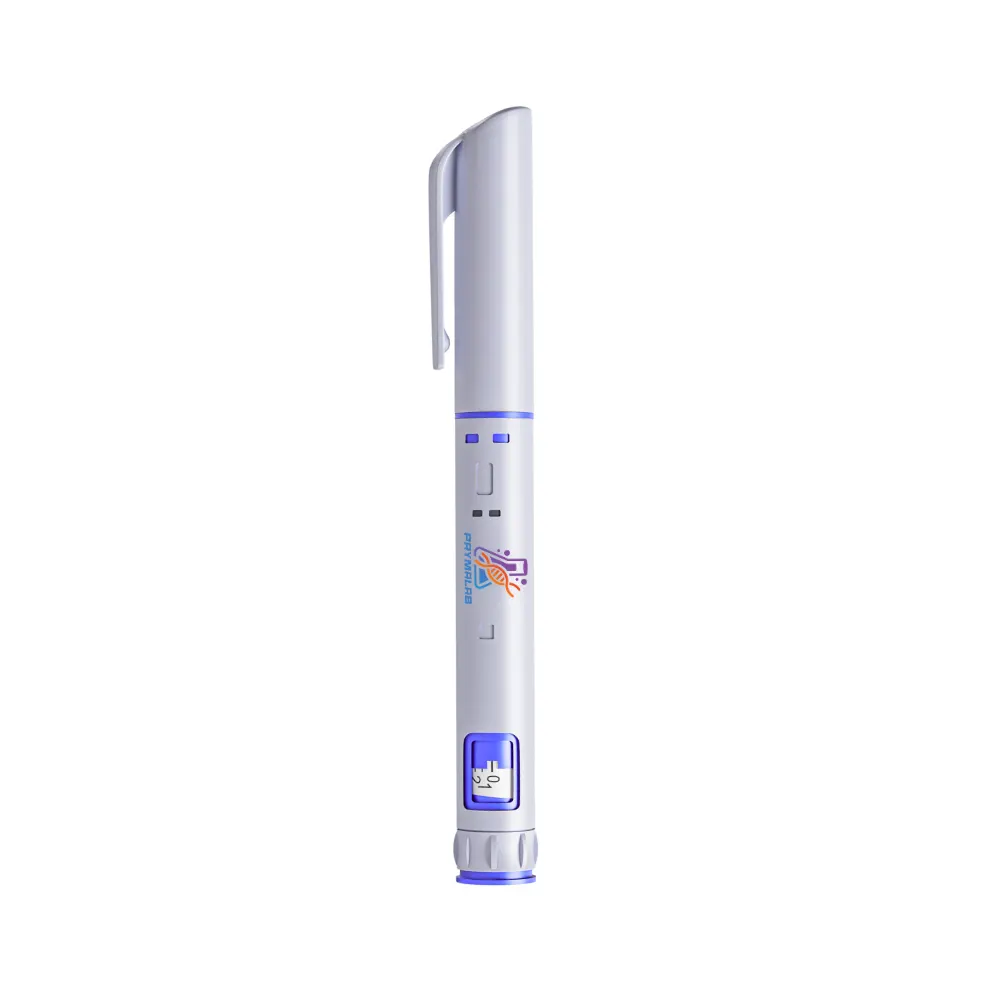
| 6 mg / 3 mL pen | Product specification of 2 mg/mL; original device image | Finished-solution content, preservative assay, sterility/endotoxin result, stability or click calibration |
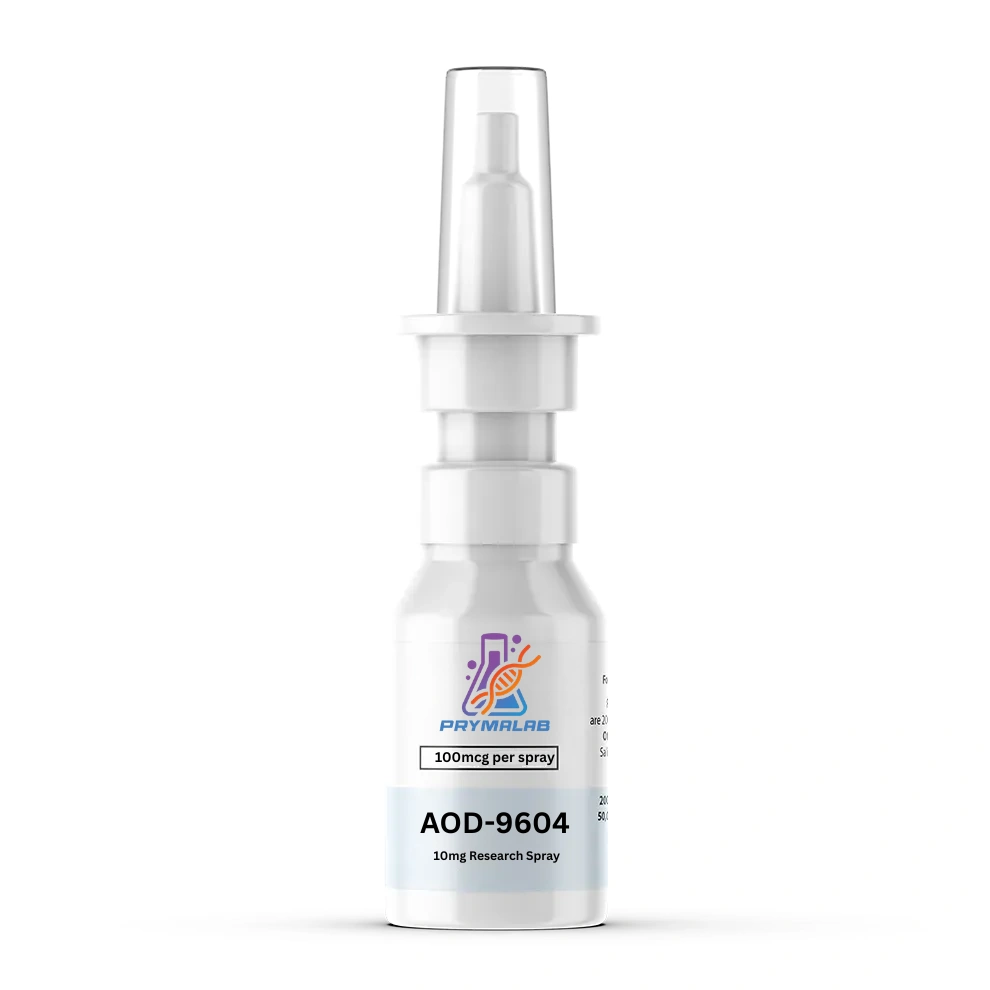
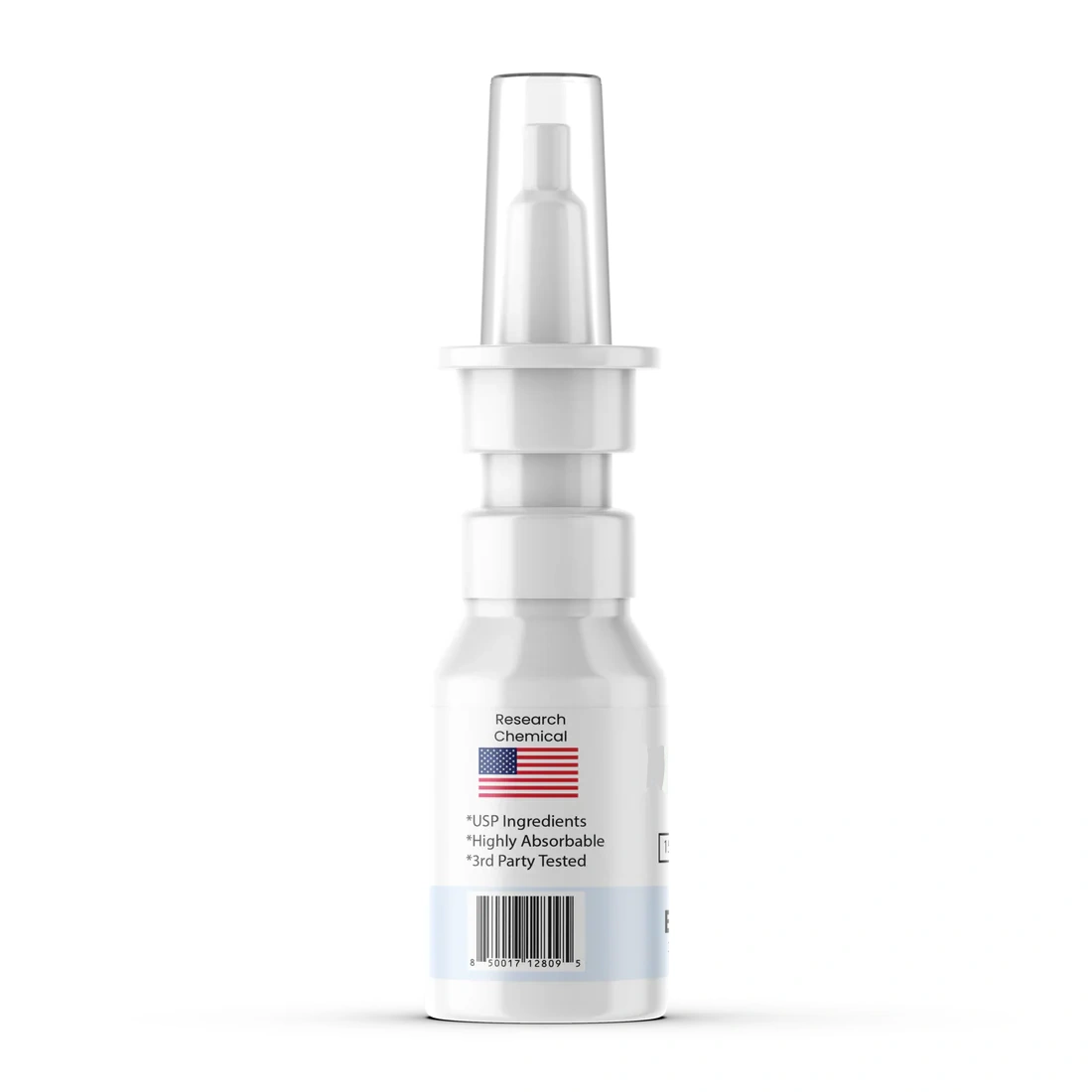
| 10 mg nasal spray | Listing and original labels, including documented disagreements | Exact fill volume, resolved formulation, delivered mass per spray, finished-solution testing or absorption |
The listings refer to tested source peptide lots. No supplied batch-traceability record connects a particular pen or spray bottle to this precise powder lot. Even a documented connection would not turn a powder test into a finished-product test.
The spray’s photographed “3rd Party Tested” wording is not supported by an attached independent report here. The supplied certificate explicitly describes in-house analysis and lists no outside-laboratory reports. Its scope also cannot resolve the 100 mcg versus 50 mcg label arithmetic or the ingredient discrepancy.
The issuing laboratory states that it retains raw data in its own system. Those underlying files were not supplied or independently authenticated. The original PDF and its numerical contents are preserved; the page’s explanation does not represent a new laboratory assessment.
September 18, 2028 is the named powder lot’s retest/expiry entry.
| Event | Date | Context |
|---|---|---|
| Made | September 18, 2026 | Powder-lot manufacture |
| Analysis | September 19, 2026 | Cover analysis date; HPLC and mass data-file dates |
| Water test | September 20, 2026 | Additional test entry |
| Endotoxin test | September 21, 2026 | Additional test entry |
| Sterility and review | October 2, 2026 | Listed sterility entry and reviewer date |
| Issued and released | October 3, 2026 | Certificate issue and laboratory approval |
| Retest / expiry | September 18, 2028 | Printed entry for this powder lot |
The certificate’s storage condition is −20°C, desiccated and dark. The printed date is not a beyond-use date for a reconstituted vial, opened pen or spray bottle. A new editorial date on this website does not renew a test or extend the report’s dates.
Keep labeled mass and liquid volume separate.
Check the amount-to-volume arithmetic and the limits of each delivery format.